17.01.25
How can osteopathy help you with bike fitting?
A bike fit is a process that ensures that the bike fits the rider perfectly. It involves a thorough assessment of your body and needs, including a dialogue about your goals and any problems, a physical examination, and adjustment of bike components such as the saddle, handlebars, pedals, and shoes.

Bikefit expert: Mads
Who am I?
My name is Mads Christensen, I have a background as a professional cyclist at World Tour level, where I rode for teams such as Saxo Bank & Quick Step.
I am a trained body therapist with a holistic mindset in how the physical and mental are connected.
My own time in the saddle and my physiological knowledge form the framework for the way I work. I use my extensive experience instead of computer-based calculations to adjust your position on the bike. This means that I first and foremost look at your physiological prerequisites for sitting well on a bike.
I see the body and the bike as a unit and a symbiosis, where your position on the bike must be in balance. It is therefore important that all components work together to achieve optimal performance and comfort.
Link to website with bikefit: https://www.adventurecycling.dk/thebikefitstudio
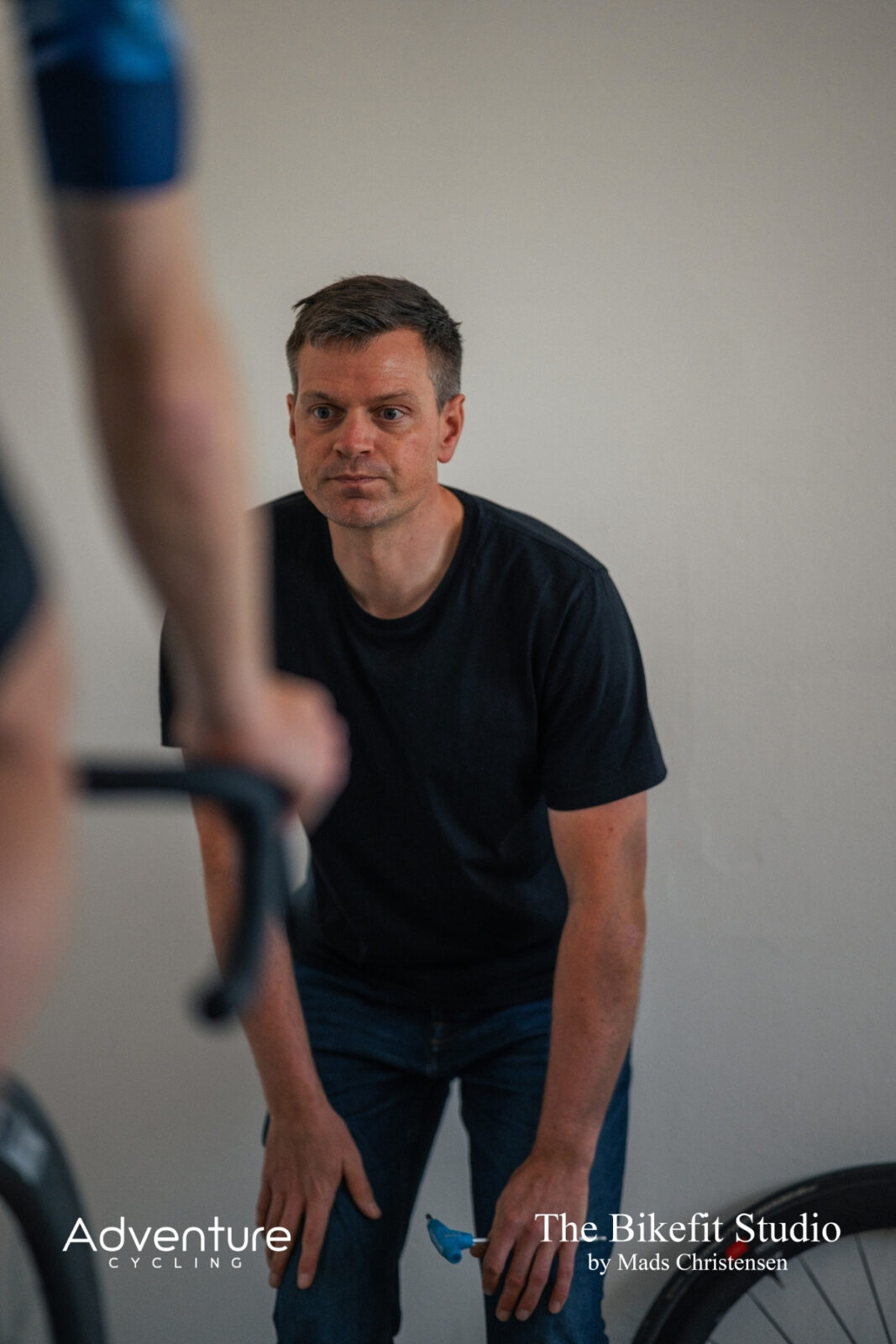
What is bikefit?
A bike fit is a process that ensures that the bike fits the rider perfectly. It involves a thorough assessment of your body and needs, including a dialogue about your goals and any problems, a physical examination, and adjustment of bike components such as the saddle, handlebars, pedals, and shoes.
Time consumption:
A typical bikefit session takes between 1.5 and 2 hours and includes:
- Dialogue: We start with a conversation about your cycling habits, goals and any injuries or discomfort you have in connection with cycling.
- Preliminary examination: A thorough physical examination of your body to identify strengths, weaknesses and asymmetries, which is one of the most important phases that tells me what adjustments and needs you need when setting up the bike.
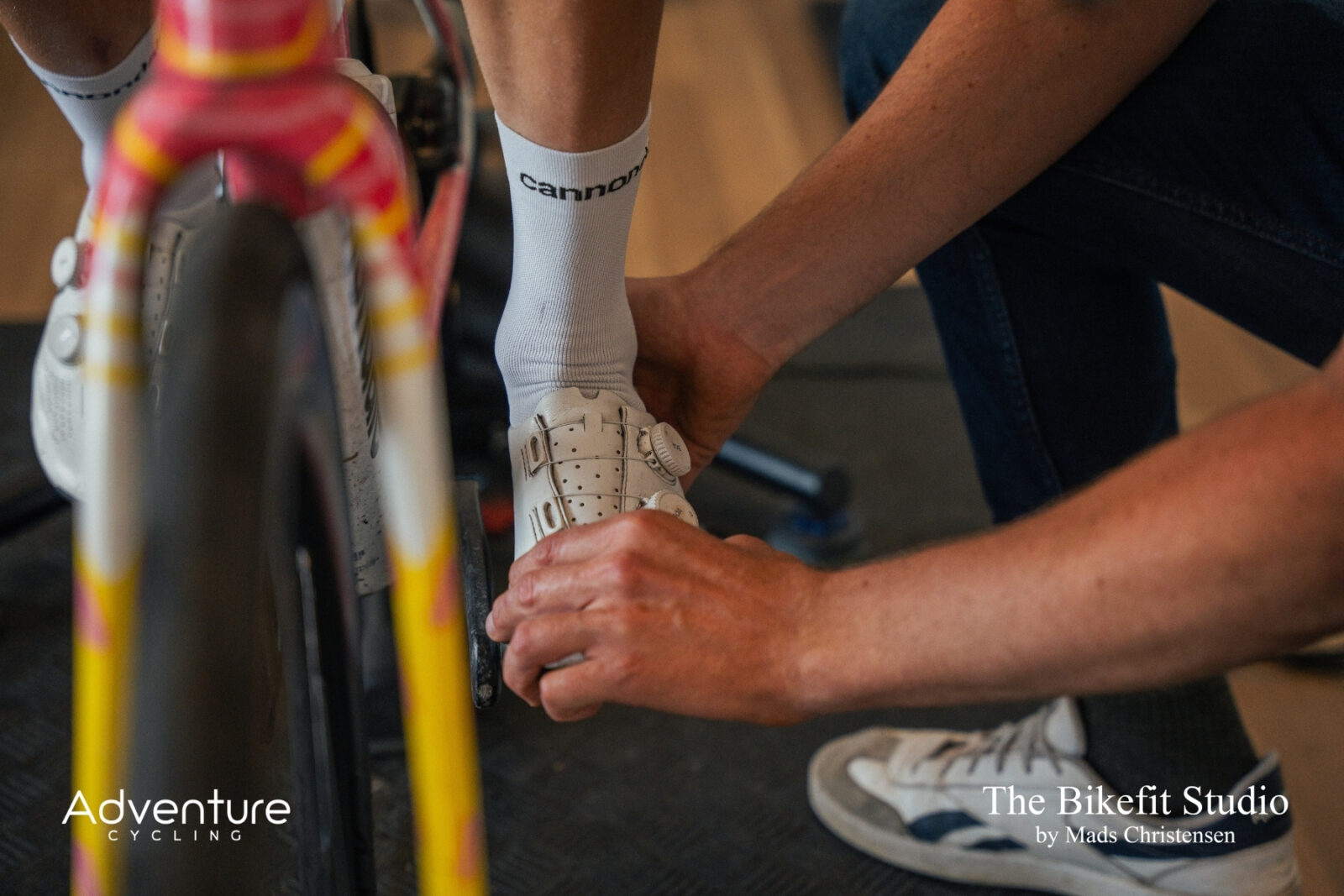
- Setup: Adjustment of the bike’s components based on the initial interview and preliminary examination to optimize your position. This includes shoe and cleat adjustment, saddle selection and adjustment, and handlebar position in relation to your hands, arms, shoulders, neck, and the rest of your upper body.
- Fit test: Here a small test is run and the final fine adjustments are made to ensure that you feel comfortable and efficient on the bike.
- Finally, the bike is measured and the measurements are noted in a Bikefit report along with various notes from the preliminary study.
Why bikefit?
A proper bike fit can prevent and treat injuries, improve your comfort, and optimize your performance. Typical injuries I see in cyclists include:
- Wrist, elbow, and shoulder: These injuries can occur due to incorrect handlebar positioning or too much weight on the hands.
- Neck: Pain here can be caused by an incorrect saddle or saddle height, as well as a handlebar position that forces you to look upwards at an unnatural angle.
- Back: A poorly adjusted bike can cause back pain, often as a result of incorrect selection and adjustment of saddle height or saddle position.
- Knee/hip: These areas are very sensitive to incorrect cleat position, crank arm length or saddle height. Many can greatly benefit from a bike-specific insole in their cycling shoes, which can provide increased stability to the feet, knees and hips, a larger contact surface, better comfort and better power transfer.
Differences between an athlete and an recreational cyclist
A professional athlete and a recreational cyclist have different needs and goals. While an athlete often focuses on performance optimization, an recreational cyclist may seek more comfort and injury prevention. The fit takes these differences into account so that both groups get the most out of their cycling.
Performance optimization and comfort
To produce the equivalent of 1 horsepower, you need to produce approximately 750 watts! How long can you sustain 750 watts?
When talking about performance on the bike, a bike fit is a must!
Not much should go to waste before you can’t deliver and perform at your maximum!
A good bike fit improves both your performance and comfort. By ensuring that you are seated correctly, you can more easily activate all the major muscle groups in the right way! This makes it easier to deliver more power to the pedals without wasting energy and without putting unnecessary strain on your muscles and joints.
Injury prevention
By preventing injuries through proper bike setup, you can avoid pain and discomfort that can prevent you from cycling regularly. This is especially important for those who cycle a lot, as even small adjustments can make a big difference.
Adaptation to discomfort, injuries and pain
If you already have discomfort, injuries or pain, a bike fit can help adjust your cycling position to reduce the strain on the affected areas. This can make a big difference in your ability to cycle without discomfort and may even help speed up your healing process!
Bikefit is not just a luxury for professional athletes; it is a necessity for anyone who wants to get the most out of their cycling, regardless of level. By ensuring that your bike fits your body perfectly, you can improve your comfort, prevent injuries and optimize your performance.
Physiotherapist and osteopath student: Emil
Osteopathy and cycling injuries
Injuries, pain and discomfort related to cycling can occur throughout the body and due to various triggering factors. Injuries can generally be divided into 3 categories.
- Acute injury: Often occurs through a fall or other trauma. Involves tissue damage.
- Overload: Compensation patterns that over time develop into potential tissue damage. In addition, lack of recovery versus training volume is also a known factor in overuse injuries, as it causes the body to be in a destructive phase rather than a building base.
- Psychological limitations: The ability to “dare” and let the body prioritize all focus on performance, rather than inhibiting physical performance due to, for example, previous crashes.

We generally see injuries and problems throughout the body as a result of cycling. However, the most common problems are related to the lower back, hips and pelvis. This is also the “pivot” in cycling, as this is where almost all power must be produced to provide the most watts possible. Typical causes of challenges here are due to the pinching of blood and nerve supply often caused by tightness in connective tissue and muscles (often hip flexors and diaphragm), reduced joint mobility, malpositions and restrictions in our organ system. The above problems contribute negatively to our performance, and the brain will therefore prioritize inhibiting these areas as a protective mechanism.
An often overlooked problem in cycling is problems related to the pudendal nerve, which can lead to pudendal neuralgia. The pudendal nerve supplies our pelvis and lower abdomen with sensory (feeling) and motor (movement) functions, including the genitals and rectum.
The pudendal nerve originates from the sacrum (S2-S4) and runs down under the sacrotuberous ligament. This ligament is also an attachment point on the ischium for two large muscles we use on the bike, respectively. gluteus maximus (buttock muscle) and the long head of the biceps femoris (gluteal muscle). Pinching the pudendal nerve can be painful and worsened by stretching the hamstring muscle or nerve and by direct compression of the nerve, such as when we sit on a bicycle saddle. Pudendal neuralgia can cause pain and/or sensory disturbances in the lower abdomen, interfere with urination and defecation and cause problems with erection. A solution to this problem can be treatment, adjusting the cycling position and changing the bicycle saddle to one that relieves the pelvic floor.
Source: https://www.ncbi.nlm.nih.gov/books/NBK544272/
Osteopathic treatment is a holistic manual treatment method that can be a valuable part of rehabilitation after an injury, or as a maintenance and preventive initiative against future injuries.