17.01.25
How do I prepare to breastfeed my child? – Good advice for breastfeeding
Breastfeeding is a journey filled with both joy and challenges for new parents. On this page you can learn how to best prepare yourself before breastfeeding, involve your partner, and get ready for a good start to breastfeeding.
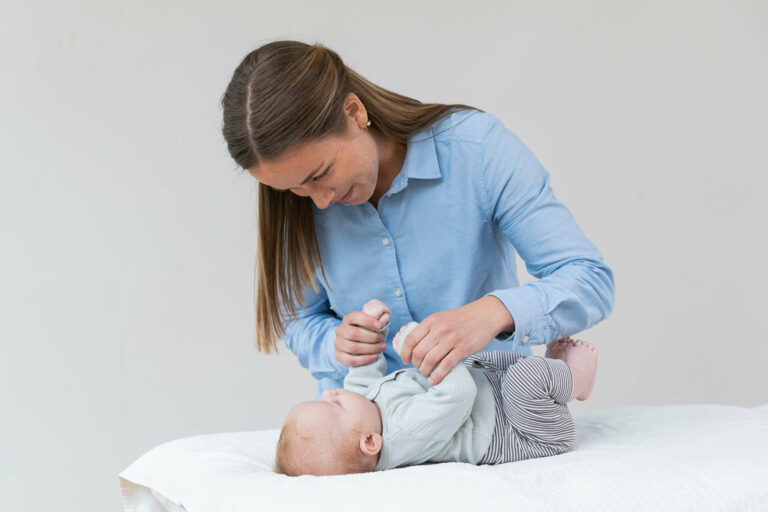
Life as a new parent offers both many great experiences and difficult challenges – including breastfeeding. Breastfeeding is a natural part of the postpartum period and is therefore often seen as something that just happens by itself.
This is a misunderstanding, and breastfeeding can be a source of great frustration for some mothers and couples.
In this article, I will talk about how you can prepare yourself and get a good start to breastfeeding.
Article by::
Sanne Christensen, Midwife and IBCLC-certified Lactation Consultant in private practice
Introduction to breastfeeding
Pregnancy, birth and the postpartum period are tough on both body and mind for many reasons. Research – and my experience as a midwife – shows that involvement, preparation and knowledge are key to a successful breastfeeding experience.
Often, breastfeeding preparation and breastfeeding are not given much importance by expectant parents – perhaps because, for good reason, they already have so much else to think about. My experience is that birth is perceived as an end goal, which results in people forgetting to prepare for the time after birth.
It is completely normal for this to be the case. However, I want to focus on the importance and significance of breastfeeding preparation and qualified breastfeeding guidance with the involvement of the father/partner and network.
Breastfeeding and partner involvement
Involving your partner in birth and breastfeeding preparation makes a positive difference. The strengthening of your shared relationship with birth, a clear division of responsibilities and a well-defined collaboration result in a safer, calmer and more tangible experience.
If you are a solo mother, I recommend that you ally yourself with a birth assistant (e.g. a friend or family member) who can help and support you – it makes a difference.
We know from research (Ogbo, 2020; Mahesh, 2018; Nilsson et al 2019) that the effect of involving your partner in breastfeeding guidance (compared to guidance by the mother alone) is:
- 14% greater likelihood of full breastfeeding 4-6 weeks after birth
- 56% greater likelihood of full breastfeeding 3-4 months after birth
- 210% greater likelihood of full breastfeeding 6 months after birth
Exclusive breastfeeding means that the baby only consumes breast milk from the mother.
Involvement means that a plan is made for both the mother and the father/partner regarding breastfeeding establishment. This does not mean that you each get your own plan – rather, it is about how the father/partner can be involved in a joint plan that is made for breastfeeding.
Good advice for involvement
- Participate in breastfeeding preparation with your partner during pregnancy – either publicly or privately (or both).
- Talk to each other about your expectations for breastfeeding.
- Write down how you can support each other and what wishes you have for the first time with your child.
- Consider whether you need or want visits in the first days/weeks after birth. If you want visits, set a framework for each visit and share them with your network already during pregnancy.
- Tell your network what is important to you in the initial stages and how they can support you in the best possible way.
Preparation
Research shows that it makes a positive difference if expectant parents prepare for birth and breastfeeding together through various forms of birth preparation. As mentioned earlier, I believe that breastfeeding preparation is generally an under-prioritized area of birth preparation.
When you are preparing, you can choose to purchase private help in addition to the public offer. Here it is important to be aware of where you seek your knowledge and guidance from. There are many titles for providing guidance on breastfeeding. A breastfeeding consultant typically calls themselves this because the person has completed further training as a breastfeeding consultant at the Competence Center for Breastfeeding. However, being a breastfeeding consultant or breastfeeding counselor is not a protected title, and therefore it can be a really good idea to investigate the background of the professional you choose to seek knowledge from.
My recommendation is to choose a lactation consultant with a healthcare background – preferably a midwife – who also holds the protected title of IBCLC. The IBCLC certification is the highest recognition in breastfeeding and requires extensive education and practical experience. The specialized training includes areas such as the anatomy and physiology of breastfeeding, breastfeeding problems and solutions, and an in-depth understanding of the needs of infants and mothers.
I distinguish between breastfeeding preparation and breastfeeding guidance in the sense that breastfeeding preparation is the part of the guidance that is included in pregnancy. Here you are prepared for the first breastfeeding and the normal breastfeeding establishment process. Here you are trained to identify when something is not normal, so that you know when to ask for outside help.
Breastfeeding guidance takes place in the period after birth.
Here you will get to know your child for the first time and learn together with the child what it means to breastfeed – it takes time, which is completely normal.
You can expect breastfeeding to be established in about 2-3 weeks, but for some it takes longer. It is therefore also very individual how often and how much breastfeeding guidance you need in the weeks after birth.
Good tips for preparation
- Write a birth letter to the midwife, expressing your wishes and expectations for the time after the birth. This could be, for example, a wish for peace in the room, a wish to wait to be stitched if possible, skin-to-skin contact with the baby and as little interference with the first breastfeeding as possible. In fact, preferably the first 60-90 minutes after the birth.
- If you have had an uncomplicated pregnancy, you can consider starting hand expression from week 36+0 – follow the instructions from the healthcare professional. If you cannot express colostrum, don’t despair, it is absolutely just as important that you get to know the breast and the technique. That way you have a fantastic tool at hand if your baby is, for example, sick in the first day after birth.
Knowledge
It can be a good idea to gather concrete and tangible knowledge about breastfeeding preparation and breastfeeding in general. It gives peace of mind and self-confidence in connection with the upcoming birth to be in possession of professionally based knowledge. If you have the time and energy to do so, you can make a list of your concerns – then you can ask your midwife for advice about these, and she can then contribute with her knowledge in the area.
It can be especially good to know something about the typical problems related to breastfeeding.
The most common breastfeeding problems I see in practice are:
- Incorrect sucking technique
- Pain – with or without visible wounds or cracks
- Lack of weight gain
- Failure to empty the breast – this can, for example, result in mastitis
- Oral motor problems in the child – this may be due to restrictions from one or more of the 7 oral ligaments
- Lack of a plan for the breastfeeding process, where a problem has already arisen early on
Many of the above breastfeeding problems are almost inextricably linked, so I rarely see just one problem without encountering several others. If the child does not suckle correctly at the breast, it quickly triggers a chain reaction of consequences that can make it difficult to save breastfeeding over time. Therefore, it is important that you, as future parents, seek knowledge about breastfeeding already during pregnancy. It is also important that you know how and where to ask for help afterwards if you experience breastfeeding problems and have not received the right help yet.