17.01.25
Burnout: Why am I always tired even though I get enough sleep?
Do you feel constantly tired and exhausted no matter how much sleep you get? Maybe your challenges are actually due to burnout - learn more about burnout in this article.

Burnout
Feeling exhausted physically, mentally or both, and feeling like your body is not cooperating, can be incredibly debilitating. There are several diagnoses behind burnout, such as Chronic Fatigue, which is now considered a somatic illness in many places – or Addison’s disease, where the adrenal glands are unable to produce cortisol and aldosterone (Source: Netdoktor). Both diseases can have different causes and many are still unknown.
In this article, however, we will focus more on conditions where you feel exhausted and drained of energy, even though you may be getting plenty of sleep, and do not have a direct diagnosis. A condition that can have countless causes, and which we within Functional Medicine try to find the causes behind. We try to do this through knowledge of physiology, biochemistry, immunology, etc., and generally everything in your environment that can affect your body and organism. We know from research that the environment in which we move has a huge impact on how our genetics are expressed, for both good and bad – you can read more about this here.
Possible causes of your fatigue?
If you experience unexplained fatigue, it is always important to look at the lowest hanging fruit first. This could be, for example:
- Sleep problems – read more here
- Diet – get advice on diet here
- Exercise habits
Here, measures should and can always be taken to support the body’s mechanisms, but sometimes without it having a major effect. Therefore, it is important to uncover conditions in the body that could lead to this fatigue. We know, among other things, that iron deficiency or B12 deficiency can lead to these conditions, as these help to form red blood cells, which are important for the transport of oxygen around the body. Here, the underlying mechanisms must of course also be uncovered, as for example. the condition of the gastrointestinal system may be the reason why the absorption of, for example. these substances does not take place.
But other causes such as metabolic problems, vitamin and mineral deficiencies, food allergies, etc. can also ultimately lead to fatigue or the feeling of being burned out. Fortunately, these conditions are often caught in the established system, but I have also experienced that they have been overlooked.
This is one of the reasons why we at Osteonordic always work closely with the established system, as we believe this benefits everyone.
Prolonged mental or physical stress without recovery can also possibly put the body in a state where it says stop. This can be through several mechanisms, where sex hormones are suppressed over a long period of time or in the same way with metabolic hormones, as a result of high cortisol levels. All of these areas can be uncovered in Functional Medicine through in-depth laboratory tests and a thorough review of the individual’s life situation.
Are stress hormones bad?
The short answer is no!
Without them, you wouldn’t survive. As described at the beginning of this article, a serious illness like Addison’s is precisely the result of an inability to produce cortisol, among other things. Cortisol helps raise your blood sugar, which is essential for us to keep going. Conversely, high production of cortisol over a longer period of time suppresses the immune system. Cortisol should ideally be high in the morning and fall during the day, so that by bedtime you start to feel tired and need to sleep.
Below you can see a figure for free cortisol measured in saliva through a DUTCH PLUS test.
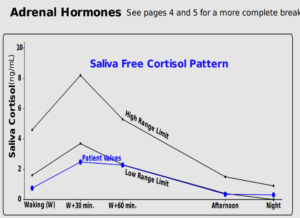
The image above shows that the client’s morning cortisol, measured in saliva, is below the normal range. This may give the impression of fatigue, but there are of course many other factors that should also be investigated before drawing a conclusion. Therefore, it is essential, for example, to also measure the metabolites of cortisol in the urine.
Burnout and Functional Medicine
Basically, we look at ALL factors that can influence your condition. This is where the holistic perspective is taken. I believe that:
Few problems have single causes, but there are often multifactorial causes – and this body view is the foundation of Functional Medicine.
Therefore, it is extremely important to uncover everything from exercise habits, sleep habits, diet, social factors and much more. Here I include all the knowledge from the formal educations that I have taken, but also all the new research that is constantly emerging. I believe that it is necessary if the situation is to be turned around for the better, and it can be extremely confusing to have to find the answers yourself, especially when energy is low. But it is rarely possible to find all the answers through conversation and probability assessment within a biological rationale. Therefore, all tests performed by your own doctor, as well as tests from foreign laboratories, are used to create an overview of where you can and should be involved in order for your body to start cooperating again.
It can be a complex puzzle, and it is therefore important to keep the big picture in mind at all times. This is what I try to do for my clients when they are in a course with me. During a course, we make a plan together, and there is the opportunity to be in contact between consultations. It is extremely important that the plan is realistic for the individual, as everyone has different resources, and of course it makes no sense to start something that is impossible to follow. Small successes breed more successes.
References:
- Funktionellelidelser.dk
- Me-foreningen.dk
- Sciencedirect.com
- Wiley – Online Library
- Sundhed.dk
- Nordic Labs
- Adam EK, Doane LD, Zinbarg RE, Mineka S, Craske MG, Griffith JW. Prospective prediction of major depressive disorder from cortisol awakening responses in adolescence. Psychoneuroendocrinology. 2010 Jul;35(6):921-31
- C. Vantyghem, A. Ghulam, C. Hober, C. Schoonberg, M. D’Herbomez, A. Racodot, A. Boersma and J. Lefebvre (1998) “Urinary cortisol metabolites in the assessment of peripheral thyroid hormone action: Overt and subclinical hypothyroidism.” J.Endocrinol. Invest. 21:21-225